A WCTU BAZAAR PRIMER
AN EDITORIAL NOTE:
We were taken to task by one Facebook reader this week when we posted an ad for the 116th Annual WCTU Bazaar. Our critic asked what probably is a quite reasonable question: "What exactly is being delivered or carried out???" Realizing that the ad does not make that completely clear, we responded: "Turkey dinners with all the fixings," to which the critic abruptly suggested, "Maybe that should be mentioned."
Note to future journalists/communicators/Rant-and-Ravers/bloggers, or whom- or what-ever survives the emerging detritus of social media and Artificial Intelligence--which we are now advised to refer to as "Advanced Intelligence" (but will not):
DO NOT assume that, after 116 years of WCTU Bazaars, your readers will know the oft-reported story of the WCTU Bazaar, nor will they know that our FaceBook posts are simply the product of this former editor/publisher's guilty conscience for having ended publication of The Canadian Record after its 132 years covering the news of Canadian and Hemphill County.
Published below is a thorough and engaging history of the Bazaar, how it started, why it started, by whom it was started and has been faithfully carried forth for over a hundred years, and what the heck is being delivered and carried out.
We hope all who read this will also attend this year's annual feast in support of the Hemphill County Library, and enjoy a treasured Hemphill County tradition.
RECORD EDITOR/PUBLISHER LAURIE EZZELL BROWN (semi-retired)

Reprinted from the December 3, 2009 issue of The Canadian Record
THE FIRST BAZAAR, held in 1906, was a three-day affair that netted $225. It was the brainstorm of a group of determined pioneer women in turn of the century Canadian. Determined to battle the proliferation of saloons and the evils of alcohol in their community, they founded a local chapter of the Women’s Christian Temperance Union in 1902.
The WCTU ladies met weekly in members’ homes, until their numbers grew and larger accommodations were needed. Dinners, suppers and other entertainment were organized to raise funds, with the group’s primary aim being to vote the town dry.
According to Sallie B. Harris’ history of Hemphill County, Cowmen and Ladies, on December 30, 1903, the women marched down Main Street carrying banners of temperance slogans, then back to the courthouse where a tent served as a voting booth. The election return was a landslide victory for the ladies. The local option to go dry carried 64 to 34.
To understand the courage of these women—and their sheer audacity—one must understand the cultural and historic backdrop against which they had organized. In 1903, women still did not have the right to vote. The legal age of consent was 8 years old. Women and children here had little access to education and no rights of which to speak.
The WCTU women took on one of the more powerful (and profitable) economic enterprises in Hemphill County—the booming liquor industry—and won. Canadian’s 40-member chapter quickly earned a reputation for being “small but mighty.” When they set their sights on buying property and building their own meeting place—with the dream that it would one day also house a public library and community center—few doubted that it would be done.
THE HOLIDAY BAZAAR owes its genesis, really, to an impromptu dinner served to a group of men who fenced off the Main Street lots the WCTU women bought in 1905 for the then-grand sum of $400. That first dinner raised $8. More than that, it planted the seed of an idea that has evolved into today’s Holiday Bazaar, at which a turkey dinner and all the fixings are fed to a community gathering every first Friday in December, ushering in the Christmas season.
The first bazaars were more elaborate affairs, at which handcrafted “fancy work” like aprons and pillow slips and other pieces of art were sold to help with the fund-raising effort. The popular events even attracted donations from supporters near and far.
So successful were the early events that in October of 1911, the WCTU held its first meeting in “the house that turkey built.” True to their lofty goals, the women persisted, and twelve years later, opened the first public library upstairs, with 250 books on the shelves.
In 1939, the first librarian was hired through the Works Progress Administration (WPA) program. A few years later, when that program ceased to exist, the City and County agreed to pay the librarian’s salary.
In 1966, the WCTU Building was dedicated as a historical building by the State Historical Society. The plaque reads: WCTU Building—the only structure in the nation built, owned and operated by a local chapter of Women’s Christian Temperance Union. Built in 1911 with financing and upkeep from Annual Bazaars held since 1906. Also used by Public Library and civic groups. Determined to abolish liquor by local option election, the Chapter organized in 1902. Won the first election a year later. Meetings have been held every 4th Wednesday since founding.
Since then, the library has undergone two major building and remodeling projects. It is now a member of the Texas Panhandle Library System and the Harrington Library Consortium, with access to library holdings all over the Panhandle.
WITH THE ADVENT of computers and the internet, the Hemphill County Library has continued to adapt and transform itself to meet the educational needs of the community.
Some things, though, have changed very little. Turkey, broth, cornbread, celery, onions, potatoes, gallons of coffee....the amounts grow from one year to the next, but the essential ingredients to which the Holiday Bazaar’s success can be attributed remain the same. Hard work, dedication, cheerful volunteers, generous contributors, and hungry diners— these things never change.
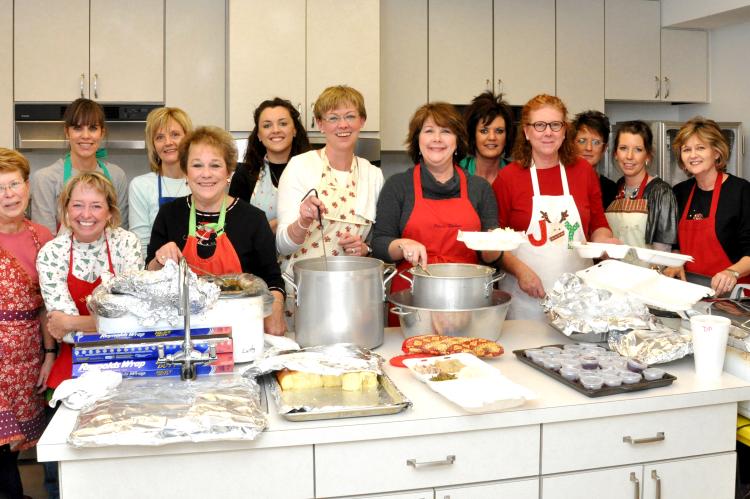
The names of the women who keep the Holiday Bazaar going vary from one year to the next, but less than one would imagine. Most are just first names, but anyone who has ever sat down to a bottomless plate of turkey and dressing in the library basement will know who they are: Bessie and Sally. Libby and Judy. Esther and Peggy and Therese and Jane. Gaydean. Betty and Kay. Connie and Dawn. Lori. Julia. Mary Alice. Diana.
These are the women who make the Bazaar happen—some of them descendants of the pioneer women who first turned their culinary skills into hard-earned dollars, and transformed those earnings into real estate and eventually, into the bricks and mortar of the WCTU Building.
These are the women who for several generations have fired up their ovens to roast turkeys—20, please...no, 22...better make that 24—who peel 170 pounds of potatoes and weep over pounds of onions and chop bushels of celery.
These are the women who recruit friends and family members and cultivate newcomers in order to muster the 70 or more homemade pumpkin, pecan, chess, custard, apple, cherry and chocolate meringue pies that will top off this celebratory community meal.
In 1986, 75 dozen rolls were kneaded and rose in towel-draped bowls before baking. In 1994, demand had grown to 85 dozen rolls. In 1985, the list of necessary tools included food processors and electric knives—implements that no doubt would have been welcomed nearly eight decades earlier when the first blessing was said and the first fork lifted.
For a century now, these rituals have marked the advent of the holiday season in Hemphill County. They have also fueled the birth and life and health and vitality of the Hemphill County Library, which owes its life to the visionary founders of Canadian’s Women’s Christian Temperance Union chapter.
And today, we stand on the shoulders of those giants.
- Log in or Subscribe to post comments.