
The Butcher Shop
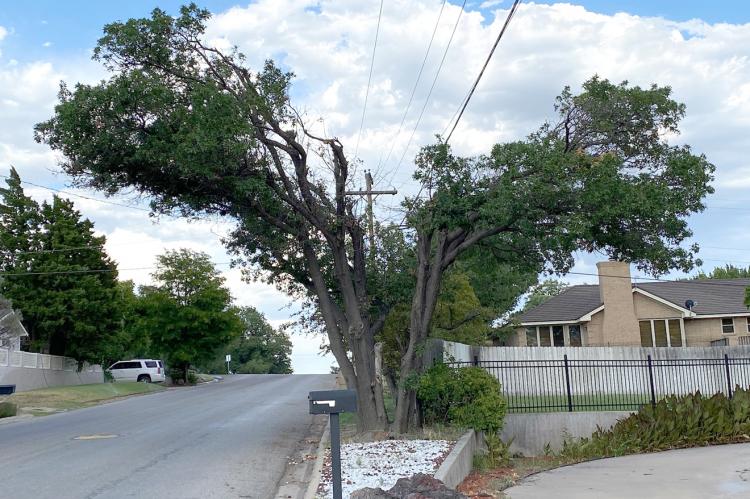
The chainsaws and wood chipper that Asplundh crews wielded in our quiet community last week were pretty raucous—but they weren’t nearly as loud as the caustic reviews their arboreal expertise earned from homeowners in Canadian, whose trees were unfortunate enough to have grown up under an Xcel power line.
Look up Asplundh.com online, and the first thing you’ll see is their slogan: Asplundh: A Better Way. Asplundh needs to look harder for a better way. The work their crew performed on trees around town could better be described as butchery—or as one displeased property owner put it, “They raped my tree.” That homeowner wasn’t exaggerating, either. After Asplundh’s workers were finished, only half of his mulberry tree remained.
We heard similar stories from other furious homeowners. Most of those we talked to had received no advance warning that Asplundh would be visiting Canadian to conduct “vegetation management work”—a task the contractor performs in communities served by Xcel Energy on a six-year rotating schedule.
We received the first report that Asplundh was back in town last Wednesday from Kate Estrada. By the time we arrived at her home on Purcell Street, the work was already done. She said the crew had already moved on to Kyle Northcott’s home on 6th Street, across from Baker Elementary.
Northcott’s lawn was already filled with mutilated branches when we arrived there, and the once-beautiful old trees were left with stumps. Northcott emerged from his home while we were shooting pictures, and said the first warning he had of what was to come was the sound of a chainsaw and someone climbing on his roof.
After receiving reports from all over town—check out the pine trees at Mert and Betty Cooper’s home on Cedar Street— we contacted Xcel Energy’s senior media representative, Wes Reeves, who always responds to our questions promptly and graciously, despite the curse of having to deal with surly, sleep-deprived newspaper publishers. True to form, Reeves patiently listened to our concerns and promised to gather more information.
By the next morning, we had this answer: “Our tree-trimming program is essential to maintaining the reliability of our power grid and keeping our customers and employees safe from hazards that could arise from trees growing into energized lines,” Reeves said.
“Every circuit is trimmed at least once on a six-year rotation, and the Canadian lines that are being trimmed at this time have not been trimmed in six years. This circuit has been noted in reports to the Public Utility Commission of Texas as experiencing high levels of vegetation-related outages. Since 2019, we have experienced 11 tree-related outages in Canadian, one of which affected some customers for more than 12 hours.” That all seemed perfectly reasonable.
But Reeves’ defense of the contractor charged with performing that task left us unimpressed, and unpersuaded. “The work of trimming trees is contracted to Asplundh, one of the nation’s leading utility contractors carrying out vegetation management work. They not only comply with ANSI (American National Standards Institute) tree-pruning standards but also follow standards developed by Xcel Energy. This type of trimming is not an aesthetic trim—our trimmers only remove what is required to comply with the standards and to prevent power outages.”
Well, “not an aesthetic trim” seemed an understatement when compared to the brutal amputation those crews had performed.
Even then, we would have accepted Reeves’ explanation had we been certain the homeowners had received timely notice of the sexennial (look it up) dismemberment Asplundh’s crews had committed. To a person, none of the grieving property owners had the slightest hint that their trees were about to be hacked. One property owner did say that the Asplundh crew had knocked on their door that morning to announce their presence.
They explained that they could remove one branch that was encroaching on the power line, and she granted permission. “When I came home, half the tree was gone,” she said. “The workers had removed two large branches and cut them down to the trunk, well away from the threatened line.
The crew returned to the crime scene the following Monday. She stated her displeasure with the excessive work they had done. In a verbal shrug, one worker said, “Well, my boss said we did a good job.”
“You would not have done this to your tree,” she persisted, which earned an apologetic, “Well, I’m sorry. I understand.”
“Prior to sending trimmers into our communities,” Reeves said, “we initiate an outbound call two to three weeks in advance to anyone served by these lines. At the time of the trimming, our contractor also attempts to contact customers in person at their homes.”
We’re not sure what initiating an outbound call means, exactly, but we’re pretty sure it does not mean that the homeowner has received a call or been warned that his trees are in imminent danger.
A letter mailed to the homeowner. A few words of warning published in the local newspaper. A simple notification to city hall or to the sheriff’s office. Heck, a shoutout on any community’s Rant and Rave page would likely get more attention than that “outbound call.”
We’d bet that most of those homeowners have ditched their landlines, anyway, to escape the onslaught of calls they get from that oh-so-familiar gang of thieves: telemarketers, scammers, and politicians.
Asplundh needs to find a better way. And Xcel “Together, We’ll Power Through” Energy needs to apologize for its poor oversight of the butchery committed by their contractors, and insist that Asplundh’s public relations team take a few lessons from Wes Reeves on how to communicate effectively with the public.
One of the things that sets Canadian apart from many communities in the Panhandle is our beautiful old-growth trees. Nobody wants their tree branches to cause a power outage. But most of the folks I know who have beautiful trees don’t want them to be butchered, and would likely prefer a little advance warning so that they at least have the option of trimming those branches themselves. That is little enough to expect from either company.