
Ceremony honoring black Civil War soldier Frank ‘Toppy’ Clark to be held here June 20
Dedication Program for Toppy Clark
10 AM, Saturday, June 20, 2026
Edith Ford Cemetery
Welcome: John McGarr
Opening Prayer: Chase Smith, Canadian Church of Christ
National Anthem
Pledge of Allegiance
Recognition of Special Guests:
-Family of Lt Col Charles Kessie, US Army
-NAACP President Alphonso Vaughn
-Major Troy Carver, USMC
-Abraham Family
-Arrington Family
Frank Clark; the Soldier: Gary Washington
Frank Clark: the Citizen: John McGarr
Missing In America Project: Joel Carver
Unveiling of the headstone
Firing Party: American Legion Post 106, Miami, TX
Taps: Chris Larson, Commander, Frontier Regiment of the High Plains
Closing Prayer: Bishop Warren Coble
Concluding Statement: John McGarr
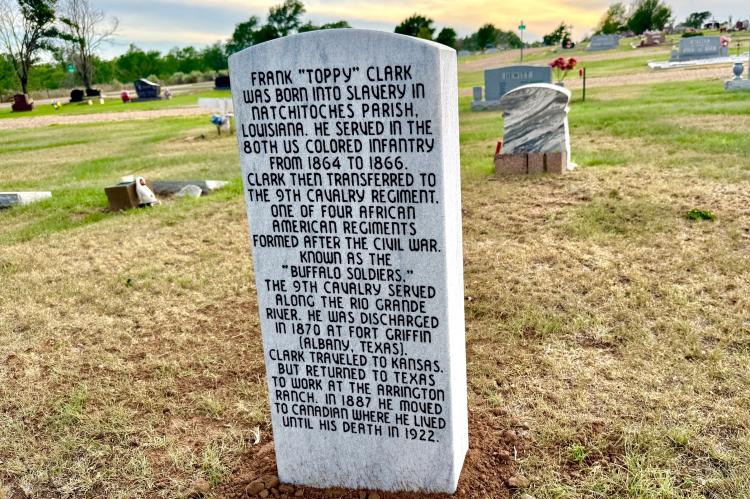
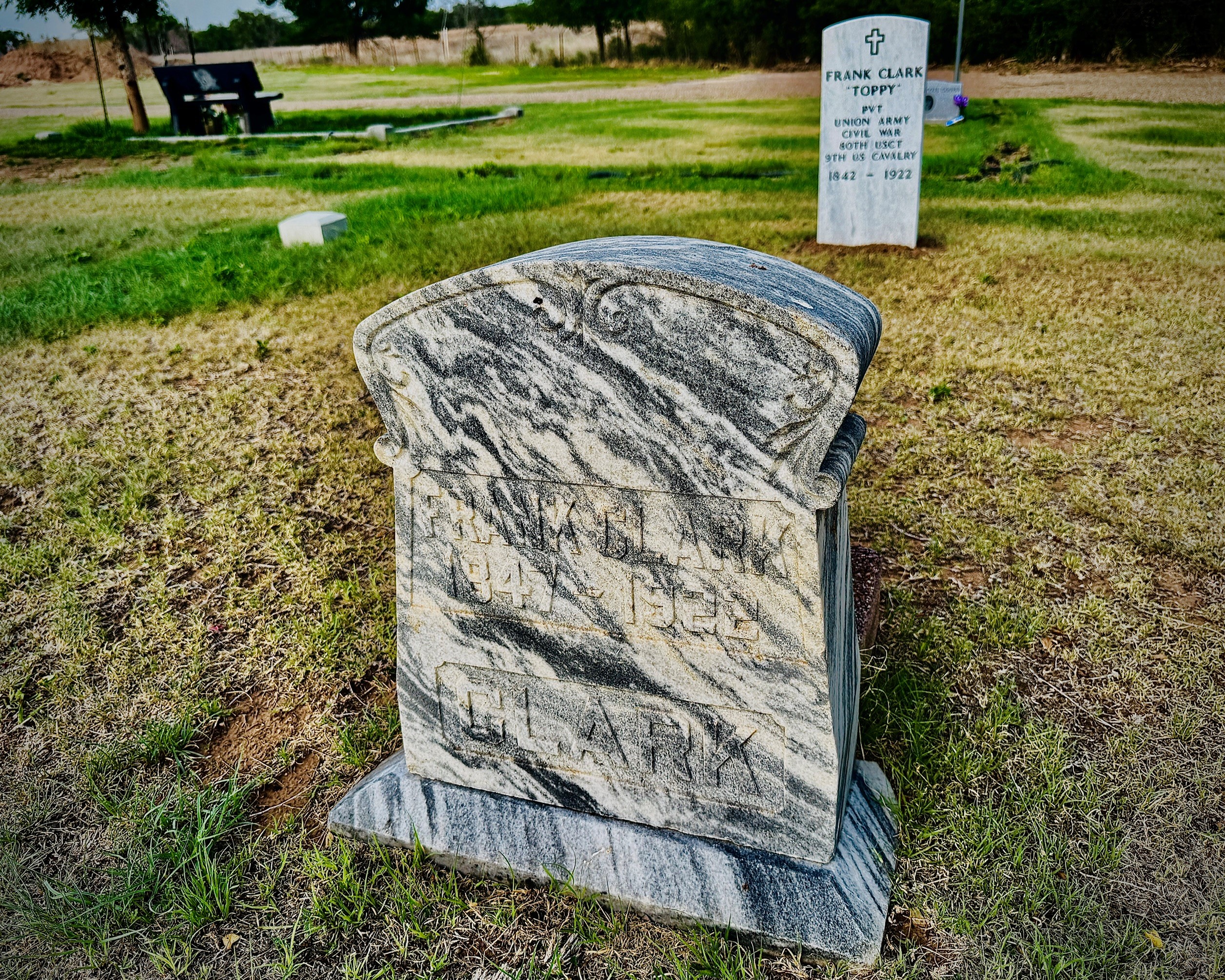
On Saturday, June 20, at 10 am, at the Edith Ford Memorial Cemetery, Canadian’s American Legion Post 56 will host the unveiling of a new headstone honoring longtime Hemphill County resident and Civil War veteran Frank "Toppy" Clark.
Clark is the only known veteran of America’s great internal conflict buried in the Canadian cemetery. Though he may have been more famously known as the only black man interred there, Clark was more familiarly—and by most accounts, fondly—known to this community’s early residents as “Nigger Toppy.”
Frank Clark was born into slavery in 1845, in Louisiana’s Natchitoches Parish. Though little is known of his early life, Clark enlisted in 1864 in the 80th United States Colored Infantry. Three years later, he transferred to the 9th United States Cavalry Colored Troops—one of four African-American Regiments formed after the Civil War and known as the “Buffalo Soldiers.” In 1870, he received his discharge at Fort Griffin in Albany, Texas.
After some time spent in Fort Scott, Kansas, in 1882, Clark came to Mobeetie, Texas, where he was a ranch cook for Captain G. W. Arrington. In 1887, he moved to into Canadian, where he drew his pension, lived in one-room shack, and was employed at various jobs and cared for by kind-hearted citizens.
After a lengthy illness, Clark died on May 18, 1922, at the age of 77. Clark’s obituary, published in The Canadian Record, carried the headline: “Toppy Clark, Sole Negro Citizen, Dies This Morning.”
The headline in the following week’s edition read, “Forty Cars Counted at Toppy Clark’s Funeral.”
“The funeral, composed entirely of white folks, might seem to be unusual,” the story noted, “but it was a simple tribute to the life of a negro who lived for forty years entirely among white folks and segregated from his own race.”
“It was also a tribute to a pioneer who came here with the first prospectors and remained to see the country develop into the best section under the sun,” the report concluded. “Toppy" had at some time worked for almost every old timer at his funeral, and had rendered good service. He had braved every danger, endured every hardship, answered every demand for his service, and acquitted himself with honor.”
Clark’s gravesite was marked by a granite stone provided by Abraham Family matriarch Alia Abraham. The gravesite was located in what was then a far corner of the cemetery—some distance from the other graves—but has since then been embraced as the cemetery grew.