Amarillo Museum of Art presents ‘Critical Mass’
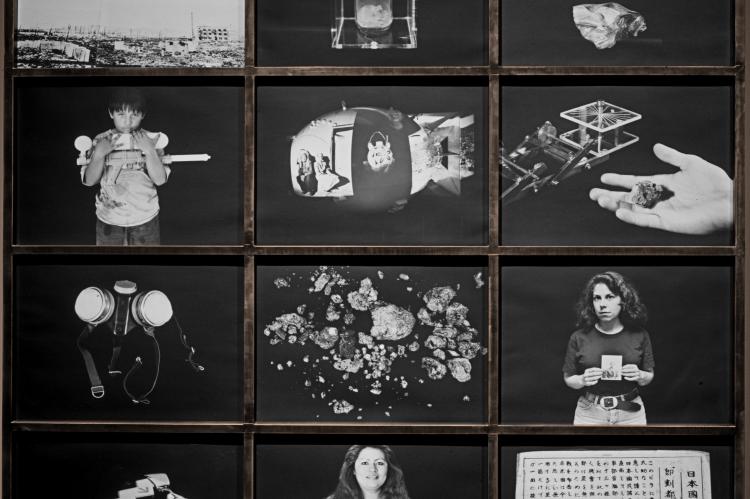
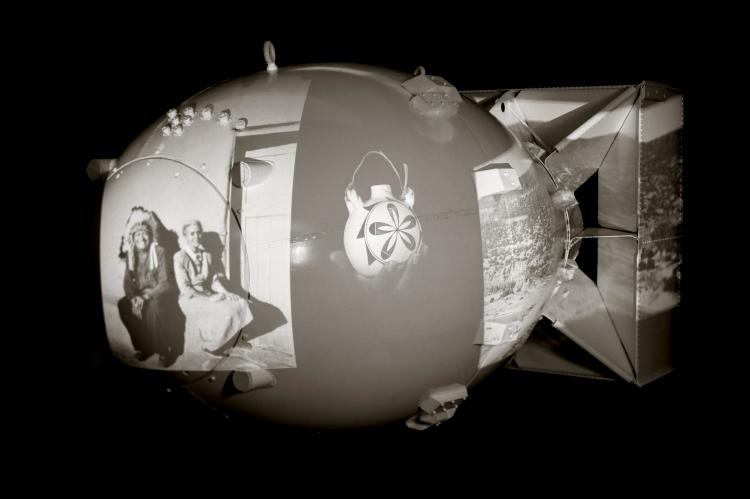
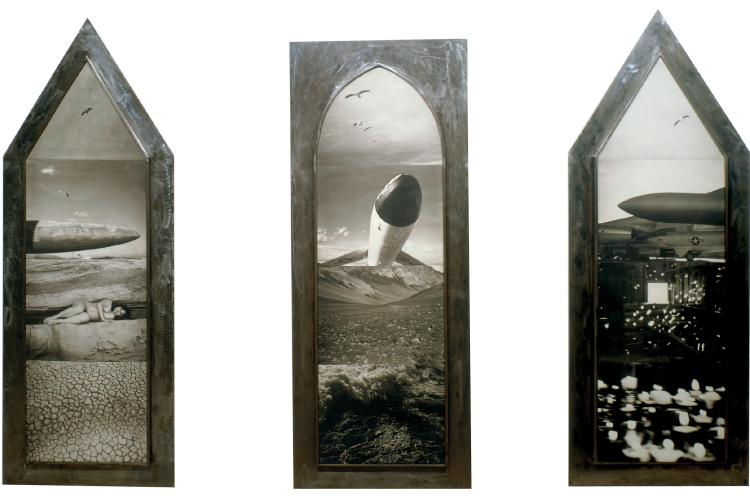
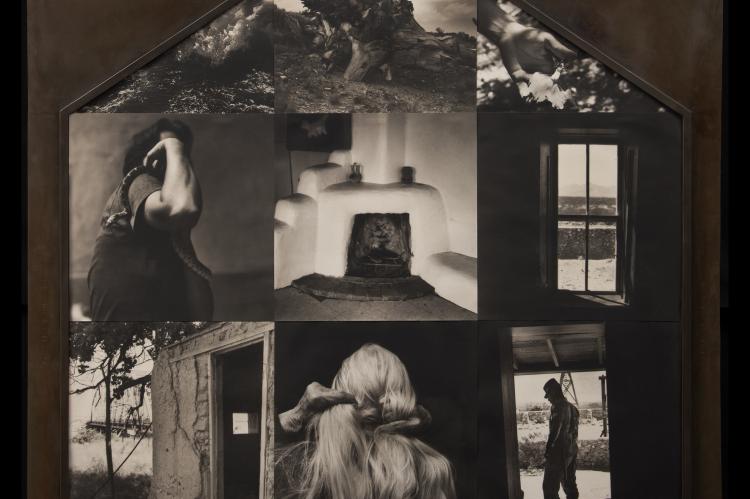
The term “Critical Mass” means the smallest amount of fissionable material that, when amassed, will sustain a self-supporting chain reaction. CRITICAL MASS was a collaborative photo/text/video installation that takes as its subject the worlds of scientists and Native Americans as they intersected at the home of Edith Warner during the making of the first atomic bomb in 1944 in Los Alamos, New Mexico.
In 1989, photographer Meridel Rubenstein and performance artist/poet-(now video artist), Ellen Zweig, received an NEA Inter-Arts grant to create the installation Critical Mass, with technical assistance by Steina and Woody Vasulka. The New Mexico Museum of Fine Arts gave institutional support for the exhibition that premiered in November 1993 in Santa Fe and then traveled for 3 years with stops including MIT's List Center, Cambridge; and the Museum of Contemporary Photography in Chicago. Presented at AMoA are Meridel Rubenstein’s photoworks and the artists’ book, They Spoke to the Angels, with Ellen Zweig’s poetic text.
The artists examined the forces of domesticity and history that led to the bomb’s creation. Their biggest concerns were the impact of large historic events on ordinary people as well as bringing mythic historical characters down to human size with their fallibilities and connection to place. The Archimedes’ Device we learned to use in early physics class to measure volume by displacing water, is an apt symbol for one world view replacing another. Here in this exhibition, the artists celebrate indigenous knowledge as equal to the scientific.
Most of the works presented in this exhibition are complex portraits: some of the people the artists came to only know through historical records; others they were privileged to meet and to photograph, which allowed them to record their memories of Edith Warner, the Manhattan Project, and the many ways their lives were affected by both.
Edith Warner’s nurturing teahouse, on St. Ildefonso Pueblo land, drew Robert Oppenheimer to her backyard to build the atomic bomb. Her home was where scientists and Native Americans first met. When the arrival of the Manhattan Project closed down her tearoom, Oppenheimer asked Edith to serve dinners to the Scientists. Her nurturing environment became the one-off-base place they could relax and meet their San Idefonso neighbors. 79 years later, the forces of nuclear destruction vanquishing domestic safe haven and the power of the Feminine, that these works evoke, are even greater. Since Albert Einstein created the Doomsday clock in 1947, we are now closest to Midnight at 90 seconds.
Meridel Rubenstein maintains her art studio in Santa Fe, New Mexico. She has been an active arts educator for over 30 years. From 2007-2018, she was a Visiting Associate Professor at the School of Art, Design, and Media at Nanyang Technological University in Singapore. From 1990-95, Rubenstein was the Harnish Visiting Artist at Smith College, in Northampton, Massachusetts. She has created photography programs at the College of Santa Fe (1976-80) and the Institute of American Indian Arts in New Mexico (1990-96) and directed the Photography Program at San Francisco State University in California, the oldest Master of Fine Arts program in the USA (1985-90).
Rubenstein has exhibited internationally including the Louvre in Paris and the Irish Museum of Modern Art in Dublin as well as in numerous gallery and museum exhibitions. Her works are in prominent collections including the Museum of Modern Art in New York, National Museum of American Art in Washington, the San Francisco Museum of Art, and the Museum fur Kunst und Gewerbe, Hamburg, Germany. She is represented in San Francisco, CA by Brian Gross Fine Art.
Meridel Rubenstein has received fellowships from the Guggenheim Foundation and the Bunting Institute at Harvard University, awards from the National Endowment of the Arts as well as the Pollock-Krasner and the Rockefeller Foundations. She was educated at Sarah Lawrence College in New York and did special graduate studies at M.I.T. with the eminent photographer, Minor White. She received an M.A. and M.F.A. from the University of New Mexico, Albuquerque, in 1974 and 1977, where she studied with noted art and photography historian and museum directors Beaumont Newhall and Van Deren Coke. Her MFA Dissertation: The Circles and the Symmetry-The Mutual Influence of Georgia O’Keeffe and Alfred Stieglitz.
Meridel Rubenstein is represented by Turner Carroll Gallery.
Exhibition Sponsor: Art Force; SEASON SPONSORS: Anonymous, Dr. & Mrs. Michael Engler, Mr. & Mrs. Alfred Smith, Dr. Kent Roberts & Ilene Roberts Balliett Foundation, David D. & Nona S. Payne Foundation, The West Family
Date: EXHIBITION DATES: September 16—December 3, 2023
Time: Museum Hours: Wednesday – Saturday, 11 AM to 5 PM, and Sunday, 1 to 5 PM
Place: AMARILLO MUSEUM OF ART is located at 2200 South Van Buren on the Washington Street campus of Amarillo College. Museum hours are Wednesday - Saturday, 11 a.m - 5 p.m and Sunday, 1 p.m - 5 p.m. For additional information, visit www.amoa.org, email amoa@actx.edu, or call (806) 371-5050 or (806) 371-5392 (weekends).
Driving directions
From I-40
Take Washington Street exit
Turn south on Washington
Turn left onto 22nd
Turn right onto Van Buren
From I-27
Take Washington Street exit
Turn north on Washington
Turn right onto 22nd
Turn right onto Van Buren
Parking is available in the #5 (north) and #6 (east) lots. Handicap parking is available in both lots.
- Log in or Subscribe to post comments.