
Field Notes: Home Sweet Slum Revisited
Field Notes: Home Sweet Slum Revisited
By Laurie Ezzell Brown
EDITOR’S NOTE: This is the text of my public comments to Canadian’s City Council Monday evening, calling their attention to the appalling condition of the Canadian Apartments, as shown in these photographs. It was my third appearance over the last ten years before city officials to make an appeal for their attention and swift action—and it was also my last. I’d call it tilting at windmills, which has a kind of noble sound to it, but after ten years, it seems a lot more like I’m drilling a dry hole.
However, councils change, attitudes change, circumstances change, and the council’s response this week was considerably more encouraging than I’ve encountered in the past.
I want to thank Mayor Terrill Bartlett, and council members Jonathan Frederick, Wendie Cook, Ben Needham and Gary Prater (Blake Beedy arrived a few minutes later) for granting me a few minutes on a lengthy agenda to state my case, and for their interest and concern. I would encourage any of you who feel strongly about the state of that apartment complex to contact them, as well, and urge their action.
I FIRST WROTE about the deplorable condition at the Canadian Apartments in 2010. Like many of you, I think I had avoided even looking at them, when I made my frequent trips to Alexander’s Deli.
But my purpose that particular Tuesday morning was to take photos of each of Canadian’s public parks, as the council had just announced that some of them would be targeted for elimination, in order to pare down the budget. Sunset Park was on the list, and it was the last park I photographed that day.
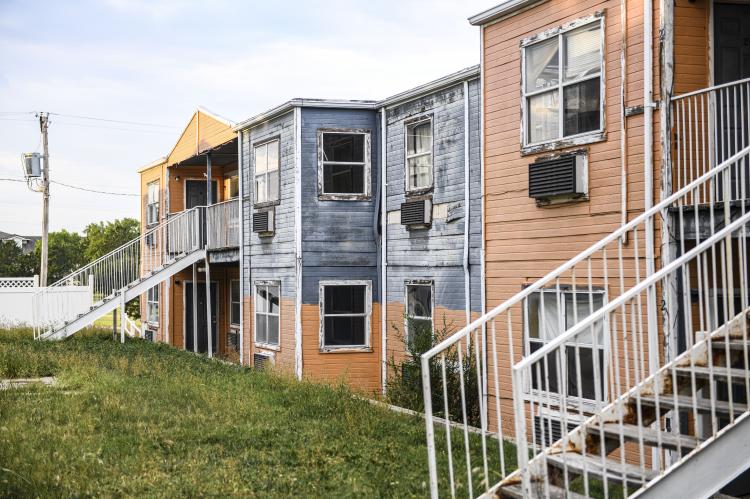
I tried to ignore the apartments, and the stark contrast they presented to the park’s beautiful landscaping and sculpture. But I couldn’t do it. Camera already in hand, I documented the state of what was then Canadian’s newest apartment complex, which at 26 years, was not aging gracefully.
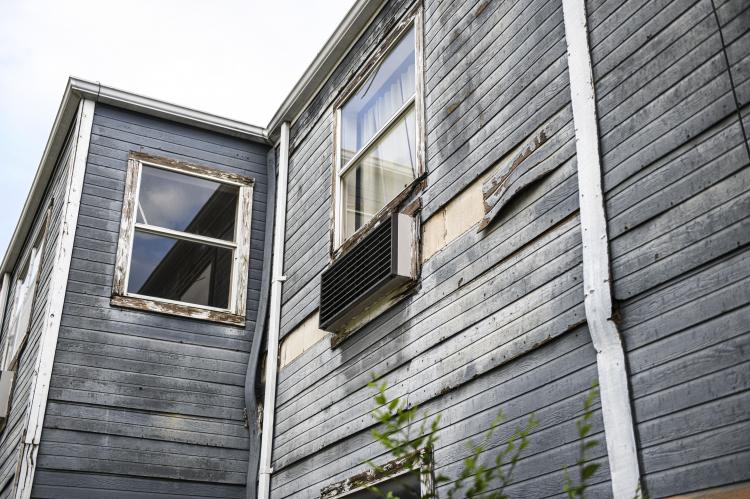
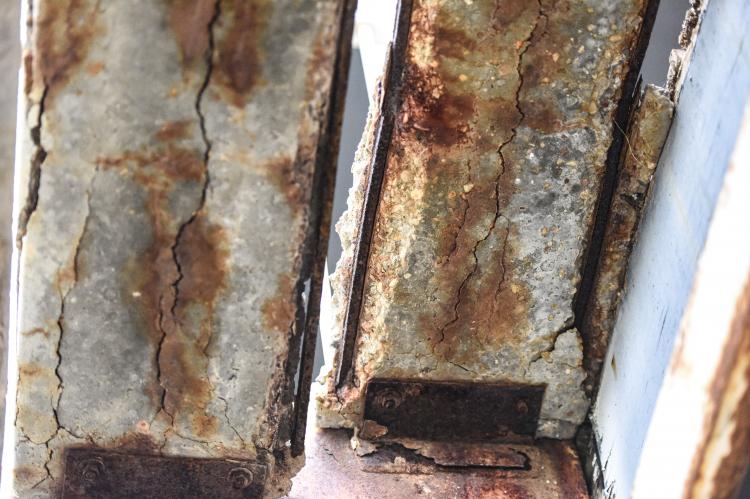
I wrote about what I had seen. The report—headlined “Home Sweet Slum”—was illustrated in graphic detail by photos. Of the rotted siding and window frames, the screens hanging by a thread. Of loose and rotting floor boards on the second floor walkways, duct-taped electrical outlets, and weeds and trash the only landscaping. Of crumbling concrete stairs, parts of which lay in chunks on the ground below.
At this point, the apartments were full. When there was a vacancy, it was quickly taken, despite the obvious state of disrepair. The local economy was booming and housing was scarce.
What those photos could not capture was the stench...of neglect, of feral cats and rats, of hopelessness. That was harder to describe, but it followed me home, where I pitched everything I’d been wearing in the washing machine and started over.
I documented the phone calls I got in response to the report we published that week. I still have the notes I took, of tenants and former tenants describing the black mold, the holes in the walls stuffed with rags, the air conditioners that didn’t workhad never worked. The ticks and fleas infesting what was left of the apartments’ worn carpeting. The toilets that overflowed, leaking through the ceiling from an apartment above. The indifference of the apartment manager to their pleas for repairs, and the threats of eviction tenants faced if they dared to complain.
What I remember most was the callers’ almost whispered voices, begging me not to use their names, or not to even ask what their names were, for fear of losing the only homes they had.
The building owners—who still live a safe distance away, in Idaho—did not care. I know, because I called them. I asked how long it had been since they had visited the property, whether they were aware of the condition they were in. I offered to send them photos, a newspaper, a free online edition of The Record so they could read and see for themselves—and of course, they refused.
Three years later, I sought this council’s intervention, begging them to enforce the city’s ordinances, to exert any pressure they could to force the owners to make improvements.
By then, the Oasis Cove apartments were open—the result, in large part, of a former Canadian resident, Charla Emery, who read our first report, and took action. Yes. One woman.
The council promised to study the legal issues involved, to request an inspection of the property by the fire marshal, and to revisit the matter the next month. But the headline on The Record’s September 5 front page read: “Council takes no action at Canadian Apartments.”
A week later, apparently feeling some gesture was required, the apartment owners paid for a few gallons of paint. The color was tough to describe. A failed attempt at orange or Wildcat gold, perhaps? The paint job was never completed.
The siding that had pulled away from the building, exposing water damage and rot, was not repaired. The warped trim and rotting window frames were untouched. Some of the stairs were replaced. To this day, the stink still remains.
One passer-by, who saw us taking a photo of the painting project, offered this keen—and somewhat wry—observation: “I think it’s going to take two coats.”
I laughed to keep from crying.
In Chapter 214 of the Local Government Code, a city’s authority to address problems like this is clearly spelled out. The document is 48 pages long. I did not read it all. The first three paragraphs were enough:
Sec. 214.001. AUTHORITY REGARDING SUBSTANDARD BUILDING. (a) A municipality may, by ordinance, require the vacation, relocation of occupants, securing, repair, removal, or demolition of a building that is:
(1) dilapidated, substandard, or unfit for human habitation and a hazard to the public health, safety, and welfare;
(2) regardless of its structural condition, unoccupied by its owners, lessees, or other invitees and is unsecured from unauthorized entry to the extent that it could be entered or used by vagrants or other uninvited persons as a place of harborage or could be entered or used by children.
Today, the apartments are vacant and clearly abandoned. The city utilities were cut off in March of this year. The city is about to invest about $360,000 in Sunset Park to install electricity and lighting—a decision I commend.
The view from that beautiful park, looking north, is the apartment complex.
Just next door, Alexander’s Deli has risen again from a devastating fire. Its owners, Tim and Betsy Alexander, chose hope. They chose to reinvest in this community, rather than to give up, despite our now-uncertain economic future.
I’m asking you to invest in our future, too.
Demolition of the building could be accomplished either as a training exercise for the local and area fire departments, or, as has also been suggested, the National Guard. I believe that local businesses with the equipment and expertise to assist in demolition would be more than happy to volunteer their services to remove this dangerous and unsightly eyesore from our southern gateway.
Decades ago, Mayor Oofie Abraham refused to give up when the Santa Fe railroad pulled 150 families from this community overnight. Instead, he decided the city would invest in new streetlights, defying the Amarillo Globe-News prediction that Canadian would be the Panhandle’s next ghost town. Oofie declared that, if so, it would be “the best-lit damn ghost town in the Texas Panhandle.”
I believe his gamble—and Oofie loved to gamble—has been rewarded, many times over.
We, too, should choose hope. Let’s not give up today.