Canadian's Memorial Day observance 2023
Memorial Day address is tribute to veteran Ray Risley

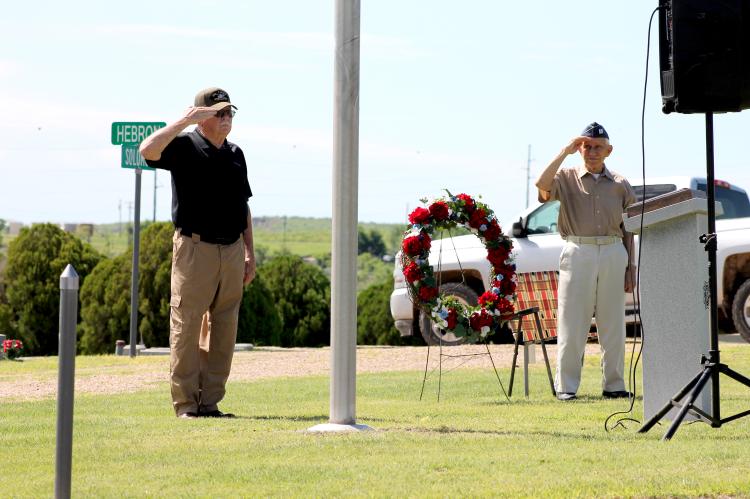
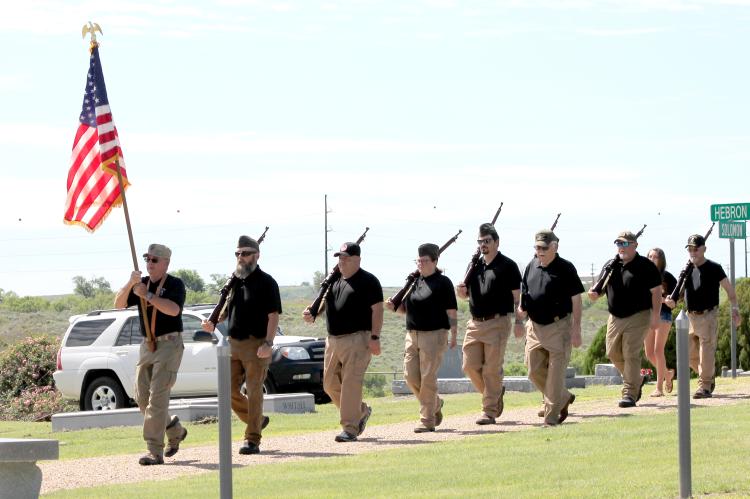
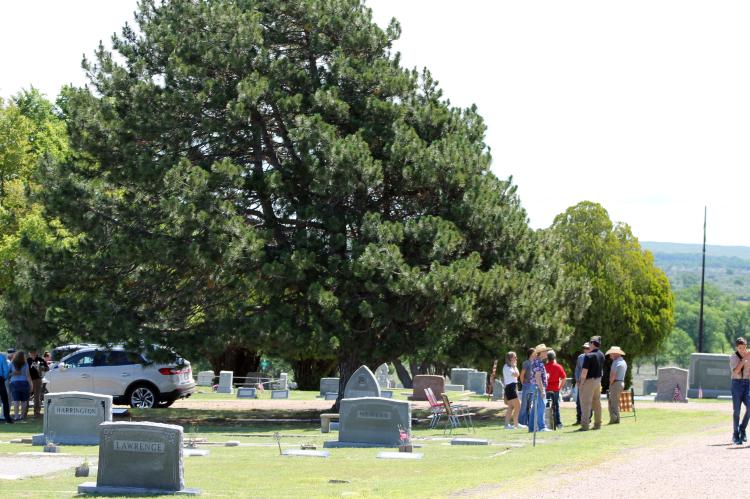
Monday, May 29, 2023, was Memorial Day and Canadian's observance at Edith Ford Memorial Cemetery saw perfect weather for the annual event.
The Honor Guard included David Parnell (flag bearer), Tommy Wyatt, John Rivers, Lacie Benjamin, Billy Benjamin, Alfred Godino, John McGarr, Jason Bradford and Warren Rivers. Dr. Malouf Abraham presented the memorial wreath, John McGarr gave a special address honoring a local veteran, the late Ray Risley. Tina Godino cued the National Anthem and Taps and Ana Lovelace assisted the Honor Guard with its presentation.
MEMORIAL DAY 2023 / JOHN McGARR’S ADDRESS
Good morning and thank you for joining us to commemorate Memorial Day, a national holiday when we come together to remember those men and women who served their nation, but who are no longer with us.
My comments today will be different from those of previous years. I invite you to join me on a trip back some seventy-nine years to 1945. Today, we know that in August of 1945, Japan surrendered and World War II ended…but the man with whom we will travel today had no way of knowing that in January of 1945.
Our young man was born in a small town in Oklahoma. His family moved to Hemphill County sometime in the 1920’s to farm. The rains came in the 20’s, World War I was over, and there was still a good market for agricultural goods. Great swaths of land in the Southern High Plains was broken out and planted to wheat, cotton, and other crops. But that was soon to change. The 1930’s brought the Great Depression, the Dust Bowl…and World War II.
After finishing high school in Canadian in 1943, our young man continued to work on the family farm until he was drafted in October of 1944. Though the Axis powers were being pushed back in both Europe and the Pacific, it was at a horrific cost, and no one could predict how long the war would last.
In the same month our soldier entered Basic Training, General MacArthur’s forces began the fight to free the Philippine Islands. By the end of 1944, the Japanese forces were defeated, and our young soldier knew he was headed to the Western Pacific.
As he was preparing to ship out, the battle for Iwo Jima began. Beginning on February 19, it lasted roughly five weeks. At its conclusion, the original Japanese force of 21,000 had lost 19,000 men killed and 1100 men captured. The American forces suffered 26,000 casualties of which 6,800 were killed.
Our young soldier had arrived as a replacement assigned to the 382nd Infantry Regiment, a part of the 96th Infantry Division. This division had led the invasion of the Philippine Islands and was now training for the invasion of Okinawa.
The invasion began on April 1(Easter Sunday), lasted for eighty-two days, and is considered the bloodiest battle of the Pacific Theater. There were over 50,000 Allied casualties with 12,000 American dead. Estimates of Japanese killed were over 110,000. 150,000 Okinawan civilians—half of the population—died, many by suicide.
This is the first time that Japan used Kamikaze aircraft. Nearly every Japanese soldier either fought to the death or committed suicide.
Most Americans viewed this as a preview of the impending invasion of Japan. Planners estimated that in the first 120 days of invasion, nearly 1,000,000 Americans would die along with 5-10 million Japanese.
But, John, what about our soldier? And why all the numbers?
Our young soldier was seriously wounded on May 24, 1945, and evacuated back to the United States. He had been overseas for four months and 28 days. He was medically discharged February 1, 1946. He returned to Canadian and farmed until his death.
About the numbers, it is my attempt to put us inside the minds of the ordinary soldiers who fought that war. The closer they got to Japan, the harder the fight. And when they got to Japan, they would be fighting nearly every person—military or civilian—there. The odds were not good.
And yet. These ordinary men were called to do extra ordinary things in the defense of our way of life. They sacrificed a big part of their lives so that we could have our lives. And they did it day after day after day, not because they enjoyed it, but because they knew they had to…like the men and women standing behind me.
Ray Risley returned home, married, and started a family. Like most veterans, he seldom talked about his war, but he did give his Purple Heart to his son, Larry.
Sadly, that medal was lost in the wildfire that burned D’Lois and Larry’s house last year. Brandon asked me for help in replacing the medal. But while doing the research, we decided to do a bit more. This display includes all of Ray’s awards and symbols of his service to our country and to us.
On behalf of Canadian and American Post 56, we thank you for Ray’s service and example.
NOTE: The Ray Risley family photo: Evan Knobloch, Haevyn Knobloch, Reagan Risley, Brandon Risley, Misty O’Quin, Larry Risley, Delois Risley, Colton Risley, Lori St. Clair, Cree St. Clair, Brittany O’Quin, Makenna St. Clair, Austin O’Quin, Landon Risley, and Cooper Oles.
- Log in or Subscribe to post comments.